The history of Moldovan wine stretches back around 5,000 years, making the land between the Prut and Dniester rivers one of the oldest winemaking territories on Earth. Grape-seed imprints found near the village of Vărvăreuca date to about 2800 BC — physical proof that cultivated vines were already part of life here in the Bronze Age. From ancient tribes to modern export markets, this is the story of how a small country became a nation defined by the vine.
Ancient Roots: Wine Before Empires
Archaeology tells the first chapter. The seed imprints near Vărvăreuca show that grapes were not merely gathered wild but grown deliberately almost five thousand years ago. The climate helped: warm summers, cold winters and rich black soils made the Prut–Dniester plateau natural vine country, and winemaking became woven into local settlement life long before written records existed.
Through antiquity and the medieval centuries, empires and principalities rose and fell across this crossroads between East and West, yet the vineyards endured. Wine was food, currency, medicine and ritual at once, and peasant households kept plots of vines as a matter of course — a habit that, remarkably, still survives in Moldovan villages today.
The Nineteenth Century: Estates and Ambition
By the 1800s, Moldovan winemaking was becoming organised and ambitious. In 1827 the Purcari estate was founded in the south-east, in what is now the Ștefan Vodă region; it would eventually give the world Negru de Purcari, the celebrated blend of Cabernet Sauvignon, Saperavi and Rară Neagră. In 1893, Constantin Mimi built the wine castle that still bears his name — Castel Mimi — a symbol of an era when Moldovan wine estates aimed to rival those of Western Europe.
Vineyard area expanded steadily, and local varieties that had been selected over centuries — Fetească Albă, Fetească Neagră, Rară Neagră — became the backbone of production alongside newly arrived international grapes.
The Twentieth Century: Industry on a Gigantic Scale
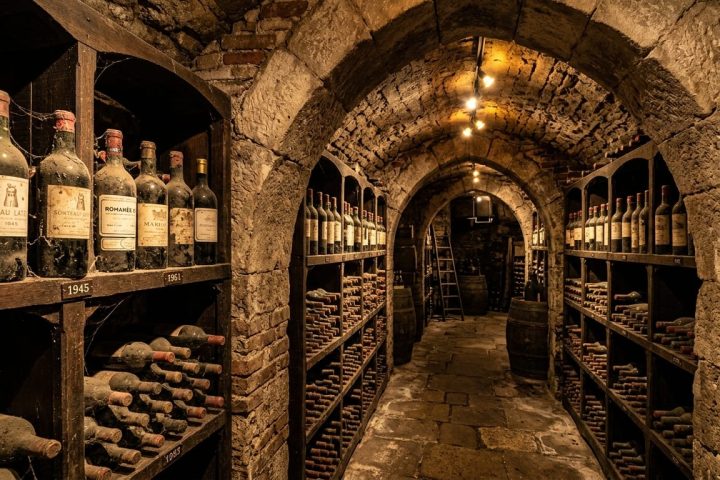
The 1900s industrialised Moldovan wine, and its monuments are underground. The limestone that had been quarried for building stone left vast tunnels beneath the countryside — cool, dark and constant in temperature, they were perfect for storing wine. In 1952, Cricova was founded inside a former limestone quarry, growing into an underground wine city of about 120 kilometres of tunnels, home to the National Wine Collection, traditional-method sparkling wine production and even an underground cinema.
In 1969, Mileștii Mici followed in another former limestone mine. Its roughly 200 kilometres of galleries — around 55 kilometres of them used for storage — hold approximately 1.5 to 2 million bottles at a constant 12 to 14 degrees Celsius, earning it the Guinness World Record for the largest wine collection in the world. The tunnel streets are even named after grape varieties. These were not mere warehouses; they were cathedrals of wine, and they remain Moldova’s most visited landmarks.
Watch: Cricova Cellars — The Underground City of Wine
To grasp the scale of twentieth-century Moldovan winemaking, you have to see Cricova from the inside. This tour explores its galleries, barrels and endless rows of bottles:
Reinvention: From Bulk Wine to Bottle Quality
The late twentieth and early twenty-first centuries brought a hard reset. Moldova’s winemakers pivoted from volume towards quality: modern equipment, cleaner cellars, and a renewed pride in indigenous grapes. The country formalised its geography with three protected geographical indication regions — Codru in the centre, Ștefan Vodă in the south-east and Valul lui Traian in the south-west, with Bălți as a traditional fourth region in the north — and protected the name Divin for its oak-aged brandy.
The strategy worked. Today most Moldovan wine is exported, about 60 percent of it to the European Union, reaching around 75 countries. A new generation of estates and small producers now bottles Fetească Neagră and Viorica beside Cabernet and Chardonnay, and wine tourism — crowned by the National Wine Day celebrations in Chișinău every first weekend of October — draws visitors from across the world.
Read also: Moldova Wine Regions Explained: Codru, Ștefan Vodă, and Valul lui Traian and 15 Fascinating Facts About Moldovan Wine
Conclusion
Five thousand years after those first grape seeds were pressed into the soil near Vărvăreuca, wine is still the thread that runs through Moldovan life. The country has been an ancient vineyard, an estate culture, an industrial giant and now a quality-focused exporter — and through every reinvention, the vine has survived. To drink Moldovan wine today is to taste one of the longest continuous stories in the wine world.
Frequently Asked Questions
How old is winemaking in Moldova?
Winemaking in Moldova is about 5,000 years old. Grape-seed imprints discovered near Vărvăreuca, dating to roughly 2800 BC, are among the earliest evidence of cultivated vines in the region.
When were Cricova and Mileștii Mici founded?
Cricova was founded in 1952 in a former limestone quarry, and Mileștii Mici in 1969 in a former limestone mine. Both grew into enormous underground cellars that are now major wine-tourism attractions.
What changed in modern Moldovan wine history?
The modern era brought a shift from bulk production to bottled quality, the creation of three PGI wine regions, protection of the Divin brandy name, and export growth to around 75 countries.